Rise Up My Soul
Oral composition
First Horton reads something in a hymn book. Then, without writing anything down, he composes a poem by using the imagers provoked by his reading to produce a visual version by using sound.
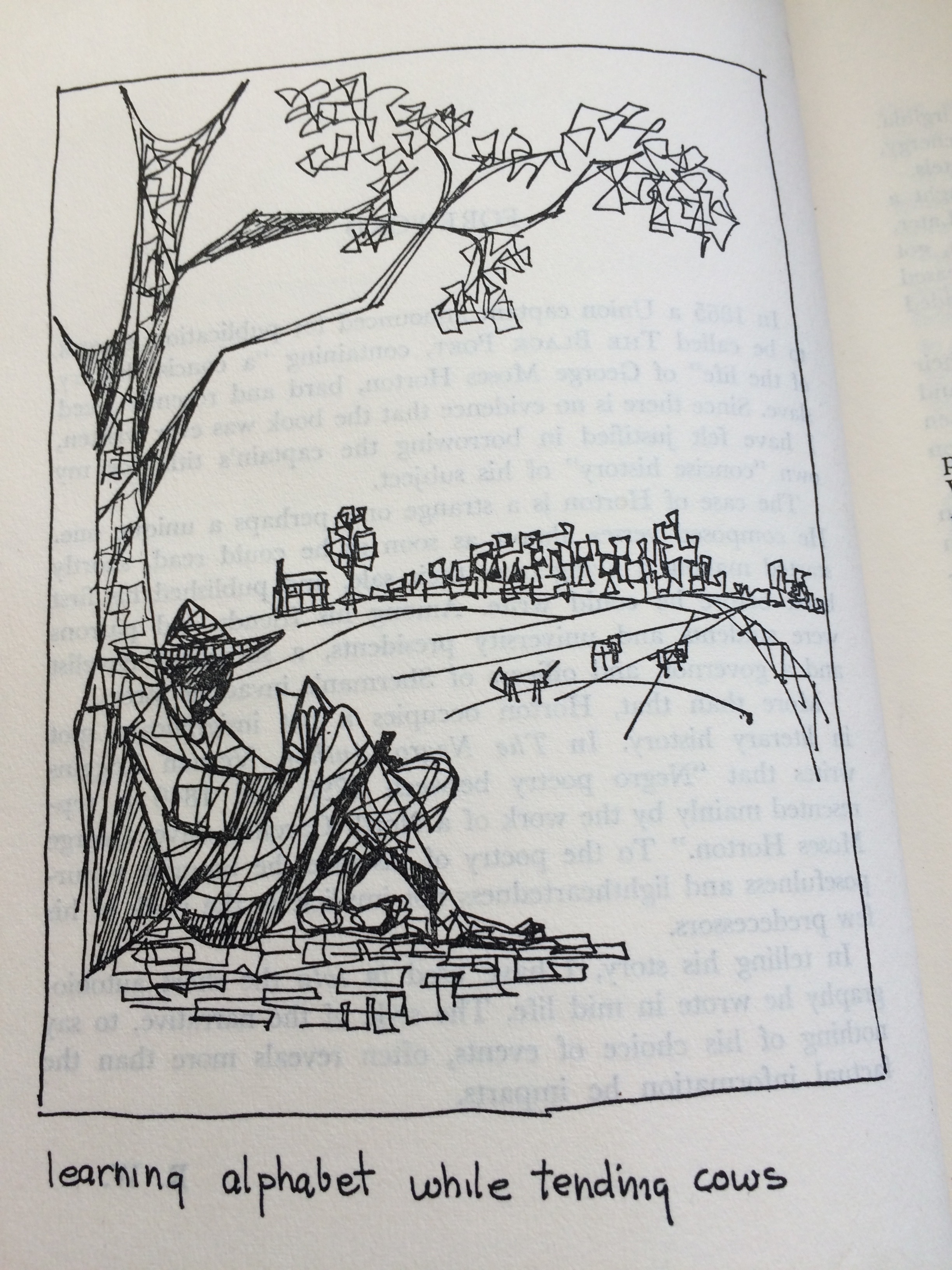
“I became very fond of reading parts of the New Testament, such as I could pick up as they lay about at random; but I soon became more fond of reading verses, Wesley's old hymns, and other pieces of poetry from various authors. 1 became fond of it to that degree, that whenever I chanced to light on a piece of paper, so common to be lying about, I would pick it up in order to examine it whether it was written in that curious style or not. If it was not, unless some remarkable prose, I threw it aside; and if it was, I as carefully preserved it as I would a piece of money. At length I began to wonder whether it was possible that I ever could be so fortunate as to compose in that manner. I fell to work in my head, and composed several undigested pieces, which I retained in my mind, for I knew nothing about writing with a pen, also without the- least grammatical knowledge, a few lines of which I yet retain. I will give you the following specimen. On one very Calm Sabbath morning, a while before the time of preaching, I undertook to compose a divine hymn, being under some serious impression of mind,”
Rise Up, My Soul
Rse up, my soul, and let’s go
Up to the gospel feast;
Gird on the garment white as snow,
To join and be a guest.
Dost thou not hear the trumpet call
For thee* my soul, for thee?
Not only thee, my soul, but all,
May rise and enter free.
“The other part I cannot now recollect. But in the course
of some eight or ten months, under similar pensive
impressions, I composed the following,”
Excited from reading the obedience of Nature to her
Lord in the vessel on the sea.
Master, we perish if thou sleep,
We know not whence to fly;
The thunder seems to rock the deep,
Death frowns from all the sky.
He rose, he ran, and looking out,
He said, ye seas, be still;
What art thou, cruel storm, about?
All silenced at his will.
Dost thou not know that thou art mine,
And all thy liquid stones;
Who ordered first the sun to shine
And gild thy swelling shores.
My smile is but the death of harm,
Whilst riding on the wind,
My power restrains the thunder's arm,
Which dies in chains confined.
“After having read the travel of Israel from Egypt to the
Red Sea, where they triumphantly arrive on the opposite
bank, I was excited to compose the following few lines,”
Sing, O ye ransom'd, shout and tell
What God has done for ye;
The horses and their riders fell
And perish'd in the sea.
Look back, the vain Egyptian dies
Whilst plunging from the shore;
He groans, he sinks, but not to rise,
King Pharaoh is no more.
“Many other pieces did I compose, which have long since
slipped my recollection, and some perhaps better than
those before you.”