Reflection on Horton Essay
The main thesis of Horton's research
George Moses Horton, Prototype Hip-hop Performer.
George Moses Horton (1797-1884) was the Ishi of black culture--the last leavings of an ancient way of thinking that the present world will never see again. We hope to use the Digital Humanities tools to recover some of this lost aura. In some instances, we will use audio and visual reenactments to capture moments that cannot be adequately represented by printed text. We call these instances “contact zones,” as suggested by anthropologist Mary Louise Pratt. Contact zones are “spaces of colonial encounters where persons of different backgrounds possessing different valences of power are in relationship.”
I use the term to describe the relationship that Horton had with his white patrons at the University of North Carolina, from 1817 to 1865. In this relationship, Horton is the colonized, and the white patrons are the colonizers.
As scholar Carole Lynn Stewart writes of Pratt’s theory, “She aims to foreground the interactive, improvisational dimensions of these encounters and to see them not in binary terms but rather as copresent and interlocking understandings and practices.” Indeed, through his poetry as performance, Horton gave expression to the meanings of performance, memory and freedom.
“It was Horton’s professed desire to be remembered for the rhythmic enactment of voice within a public space of his peers,” Professor Stewart observes. This description of “the rhythmic enactment of voice” sets Horton up as a prototypical hip-hop artist.
His poetry falls into two categories: poems published before he could write (The Hope of Liberty) and poems published after he learned to write (Poetical Works, 1845). His work charts the disappearance of the African worldview (oral) and the appearance of modernity (writing).
Born in 1797 to a slave master William Horton, the poet was a cowboy for ten years, and learned the alphabet in secrecy.
One of his duties as a slave was to walk eight miles every Sunday to sell fruit to the students at the University of North Carolina. The students would “prank” him and he would “stand on a pedestal and ‘sprout’ “—i.e. rap free style poetry.
”I would stand forth and address myself and extempore before them,” he later wrote. When the students began to make fun of his attempts, he was humiliated. “I abandoned my foolish harangues,” he later recalled, “and began to speak poetry which lifted the students still higher on the wings of astonishment.”
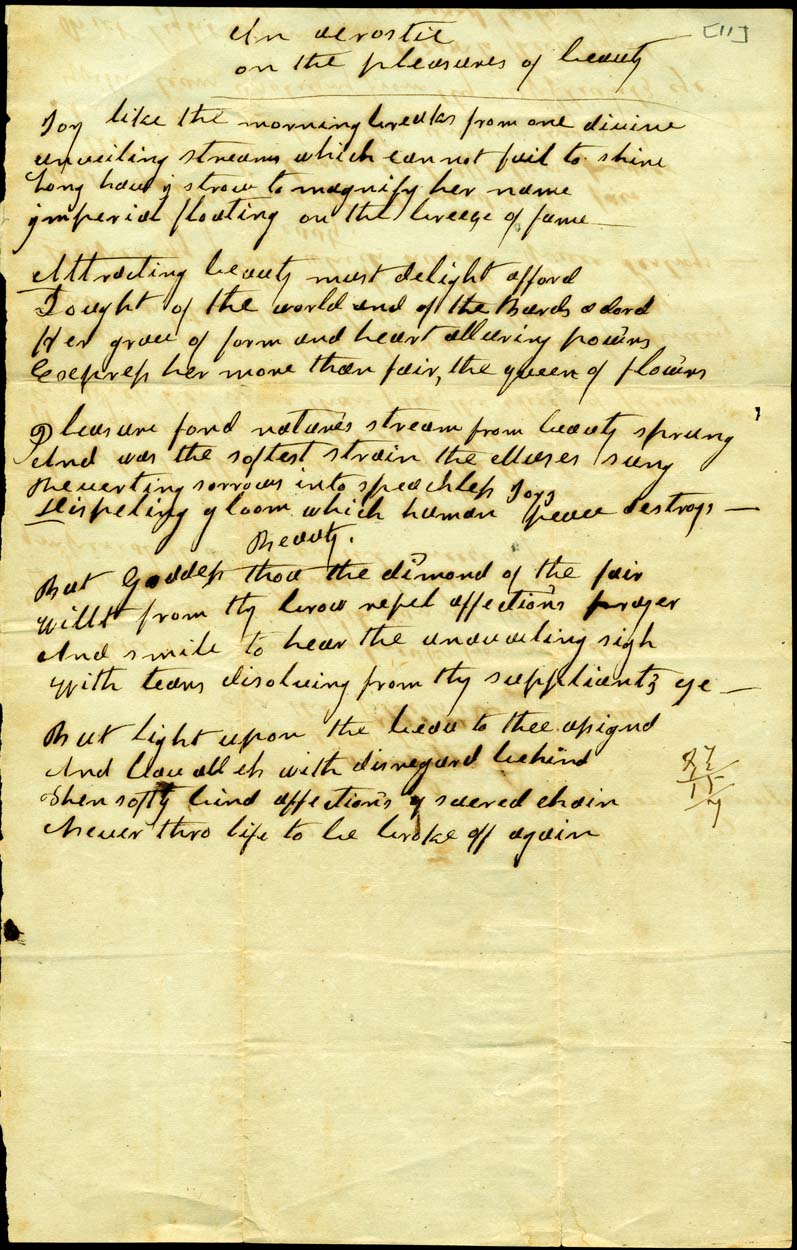
To prove that he could compose orally, he accepted their challenge to compose an acrostic, the most difficult feat in oral composition. Seeing Horton’s gift for verbal improvisation, one student from Georgia, Augustus Alston, offered him $.25 to create an acrostic on the name of his girlfriend, Julia Shepard. To the amazement of the onlookers, Horton improvised a poem in which each sentence began with a letter in Julia’s name. The acrostic is a form of verse that only a gifted rapper freestyle or oral poet could achieve with ease, so Horton’s quick mastery of the skill was an indication of his poetic talent.
But who was this Augustus Alston, the student who led Horton to realize that his lyrical gift had monetary value? A letter from one of Alston’s fellow students, Leander Hughes, to Hughes’ father sheds some light on Alston’s character. According to the letter, Alston and a friend “last Thursday night, got drunk and assaulted two faculty members with a stick and a load pistol.”
From this primary source, we learn more than we have before about the kind of man who would inspire and encourage a Black poet.
It was students like Mr. Alston who made Horton famous on the college campus.
Before long, other young students were paying Horton to improvise acrostics on their girlfriends’ names. In a short time, Horton became famous on the campus of UNC Chapel Hill.
Soon, Horton was earning $12 a week writing and reciting poems. At a time when one could buy an acre of land for two dollars and twenty-seven cents, that was a considerable sum. He became a kind of Jay-Z on the campus of the University of North Carolina from the years 1822 to 1865. Although a slave, Horton became a superstar among the students and his admirers, including Polk, the 11th US President.
The Chapel Hill Village.
When Horton arrived in Chapel Hill in 1817 to sell fruit to the students on Sundays, the village consisted of barely a few buildings. However, there were a few people who arrived about the same time that Horton did and with whom he would found friendships. One of these people was Nancy Hilliard, a young white woman, who managed the only hotel, the Eagle, in the village. “Miss Nancy,” as she was known, served the students for over forty years. Horton worked for her as a servant.
Horton also became acquainted with four other slaves who worked at UNC Chapel Hill. In his authoritative history of the university, Kemp Plummer Battle described them as the “college servants.” One of them could bark like a coon, another would let you split a board on his head. This was a slave that was called “the missing link,” because of his resemblance to an ape, In my research, I was surprised to find a photograph of “Ben Booth,” which was taken by Collier Cobb, a professor at the university and one of the earliest scholars to write about Horton.
In four years, as one scholar claims, Horton went from being a fruit peddler to an orator to an amateur versifier to a professional poet. As the first African-American to earn a living from his poetry, Horton earned enough money to buy his freedom several times, but his master wouldn’t sell him. Therefore, instead of hoping for freedom, he began to “hire” his time by paying his master enough money to hire other slaves to work in his stead on the Horton plantation in Pittsboro, N.C.
Caroline Hentz, the white wife of a French professor, heard Horton recite his poetry and suggested that he allow her to write his poems down on paper. Horton eagerly agreed. Mrs. Hentz, herself a well-known poet and novelist, sent two of Horton’s poems to the Lancaster Gazette in Massachusetts. The Gazette, which published “Liberty and Slavery” (April 28) and “On Poetry and Music” (June 24). This was to be the first poetry ever published by a slave. Abolitionist William Lloyd Garrison published the first of these poems on the front cover of his magazine The Liberator, the famous abolitionist journal.
As a reaction to this abolitionist publication, the North Carolina Governor John Owens decided to allow Horton to publish a book of poems, The Hope of Liberty (1829).
Black anti-slavery activist David Walker read Horton’s poem in, The Liberator. Walker was born a free black man, but he was determined to fight against slavery. He set up a defense fund to “free Horton.”
Four months after Horton published his book of poems (The Hope of Liberty), Walker published his prose tract, The Appeal. This was addressed, Walker said, not to the white students but to the slaves themselves. Slaves who could not read, he suggested, should find somebody to read to them. The message in the Appeal was that Black slaves should love each other and fight to overthrow the white slave master.
The Governor Owen, who had previously offered to buy Horton’s freedom, now reversed himself. He put a bounty on the head of David Walker and passed the most stringent laws ever against slave literacy. One of the new laws included a strict penalty for whites like Caroline Hentz: “For whites who taught slaves to read or write,” he wrote, “the court will fine them a hundred dollars and forty lashes in public.” For slaves, the second offense was to be hanged. The Governor’s reasoning was that if slaves learned to read and write, they would not be satisfied with their status in life as slaves.
There was some reason to fear this. After Horton began to publish, he became a changed man, a more introspective person. He sensed that when Caroline Hentz called him “Mr. Horton” she bestowed on him a unique dignity as a man and civic leader.
Those in support of Horton’s liberty hoped to raise funds for Horton’s passage back to Liberia by selling his book. Horton, however, did not want to go to Liberia. The project to buy his freedom was crushed and Horton remained a slave until the Union Army freed him in 1865.
One of the lieutenants in the army was William Banks who, upon meeting Horton, disbanded his troops and devoted the rest of his service in the army to seeing that Horton’s last book, The Naked Genius, was published.
Upon the publication of the book, Lieutenant Banks returned to his wife and two children in Michigan, and has not been heard of since.
Digital humanities can help us reconstruct the world of George Moses Horton; by evoking the aural and auditory world in which most of his compositions occurred, digital technology allows us to experience his poetry in its truest form possible.
Using the tools of audio technology, we can reconstruct what Horton must have sounded like to his audience. By utilizing geospatial technology, we can retrieve Horton’s world and the University of North Carolina at that time.
INFLUENCES ON THE PROJECT
Some important influences have included V. Brown and his work, The Reaper’s Garden. A second influence is Prof Fox Harrell, from M.I.T. Prof Fox developed a program called Chimera, which affords an understanding of player’s “passing” through the Gatekeeper. In Horton’s time, such “passing” from one environment like the Pittsboro plantation to the world of the university can best be seen as a game like Chimera.
For example, in a new movie, called Her, the hero is in the future, where Her is a programing system, Samantha, that the hero falls in love with. Like Horton, the hero of the film, has to dictate to others because they have lost the sense of emotions (because they are always focused on their screens). Prof Harrell commented on the film Her in a way that shows the significance of Horton relationship to the technology of writing. “We should never mystify technology to the point that we forget that it was imagined, and then created, by humans based on human values to attempt to fill human needs and desires” he wrote, “The technologies shown in Her reveal some of the of values of their creators and the society in which they exist.”
Horton’s method reflects the values of the society they lived in just as the Her film reflected the values our society.
Horton’s life as an oral poet dictating to a people who had lost their feelings is an allegory of the world we are living in now.
After Horton did learn to read, he produced Poetical Works in 1845.
If we compare his first book (with oral) and his later works (chirographically produced), we will share in a rare opportunity to see how the human mind traverses from the oral to the literate state of perception.
This is an opportunity to study the influence of oral technology and digital technology on the production of literary art.
Horton had a contemporary's view of slavery. For example, he said, “The privation of liberty brutalizes and dulls the enterprising spirit… It is a death blow to the pleasures of human life.” By using digital technology, we can rediscover a world that has been lost to human environment and contemporary and early American life.
Studying Horton’s work, we have the opportunity to discover a new worldview that has recently elevated a slave poet to the pantheon of great American poetry. When he died in 1883, there was no notice of his passing or the circumstances of his demise; and no one knows for sure where he is buried. Digital Humanities can provide map geospatial studies of the 350 miles from Pittsboro to Philadelphia, from the heights of slavery to the beginnings of the 19th century, modernity of electricity and streetcars.
Essentially, we can use Digital Humanities to assemble a more unifying view of Horton’s world.
Are there any authentic images of Horton? One of Horton’s scholars was Collier Cobb, who was an early photographer. As head of the geology department at UNC for forty years, Cobb, owning one of the first camera, set up a darkroom in 1890. He took pictures of “Negroes,” who worked at the university, like Ben Booth. It is highly likely that he took a picture of Horton, because he had such high regards for the man he considered a genius. Professor Cobb met Horton in Philadelphia in 1883 and gave a lecture on Horton at Harvard in 1886. If he did take a photo of Horton, it has been lost or is waiting to be discovered.
What can digital technology tell us about who wrote Horton’s poems down? Who are these white men who so loved Horton and held him so high in their judgment? Perhaps Digital Humanities can shed some light on this important figure in American Culture.
TOOLKITS AND TEXTS
Moviestorm
Aeon
BOOKS
1 -Placing History: How Maps, Spatial Data, and GIS Are Changing Historical Scholarship, edited by Anne Kelly Bowles, Digital Supplement edited by Amy Hillier. 2008.
2 -Vincent Brown, The Reaper’s Garden, Harvard University Press, 2008
3 -Cecil Brown, Stagolee Shot Billy, Harvard University Press, 2003
4-Fox Harrell, Phantasmal Media: An Approach to Imagination Computation and Expression (MIT Press), 2013.